I’ve been meaning to post this image from the headwall of the Wailua gorge, also known as the Blue Hole. This photo is not a montage or faked in any way, just taken with a 15mm fisheye lens.
As you can see, it’s not usually blue, and only if you carry a fisheye lens does it look like a hole. Did I mention that I don’t like the name “Blue Hole?” It just seems so corny and obviously contrived. But I recently heard that it was so huge, you couldn’t capture it in one image, so I wanted to put that myth to rest.
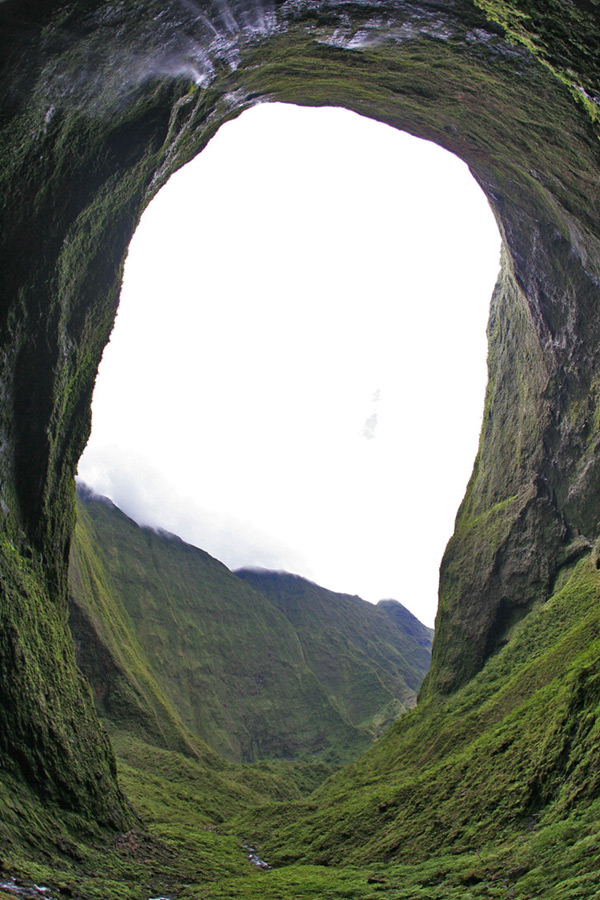
Source: Paul J. Neiman
On this topic, I just received a very interesting comment on my post about the Wailua Headwaters hike. Essentially, the comment says that increased exposure of this route in the Ultimate Guide and on this blog specifically has led to more hikers, caused side trails to be worn in the wrong directions, and allegedly prompted unhappy local hikers to remove the flagging that did exist.
This marks a turning point of sorts for this blog, one I knew would happen sooner or later, and one that I’ve been dreading somewhat. It’s the point at which it seems like the information I share has a negative impact on the Kaua’i I love.
It’s all fine and dandy to post pictures of rainbows and waterfalls for people to enjoy from afar, but then people see a beautiful place on this blog and want to go there—it’s called tourism and it’s Kaua’i’s largest industry. And it’s not just visitors, there are a fair number of residents who want to go exploring too—mainland transplants like myself who might be considered long term visitors. So they start asking around, then they start tromping around, and before you know it, it isn’t the way it was before. Except here it’s not the Hanalei full of illegal vacation rentals, or the Kapa’a strip malls full of mainland chain stores, it’s the wilderness areas I care about full of people and their tracks.
As to what effect can be directly attributed to this blog, I’m probably exaggerating. Especially when the Ultimate Guide is also involved, and it has a bad reputation for transforming places it mentions. After all, that’s where everyone learns about the Blue Hole, even myself way back when. But the commenter says the hikers mentioned to this blog, and so I can’t say I didn’t contribute.
I have many conflicting thoughts on this matter:
- Foremost in many people’s minds is the hypocrisy of hikers such as myself. We want to go to the remote places, we want to boast about it a bit, and then we don’t want others to go because it won’t be wild or remote anymore. I do admit that I wanted to blog about those places for the novelty factor. After all, any tourist can go on the established trails and flickr is full of trail photos from all over Kaua’i. But I would genuinely love for people to discover the beautiful places I’ve seen, if they have the ability to go.
- But I suppose I’m also blind to the sheer numbers. I might go twice in a year to the same wilderness area, and even if I do some route-finding and trample a little bit, it’ll hardly be noticed. But even if 5% of Kaua’i’s one million annual visitors go hiking, and 1% of those try to go to the Wailua headwaters, that’s 500 people more than before. More significantly, with a group of hikers almost every day, the vegetation probably can’t recover and erosion will begin.
- I have no real way of guessing who puts up the trail blazers in the first place. Hunters or local hikers could be marking their routes, or visitors wishing not to get lost could be doing it too. Personally, I’ve never put up or taken down a trail blazer. So, why did someone take down the flagging? To keep people from going? It seems too late for that, but I suppose if more people fail, and word gets out that it’s extremely difficult again, that might happen. Of course, it just takes one person to decide they don’t want the flagging, at least until someone decides to put it back.
- With trailblazers marking the most direct route away from dangers, I think the damage to the vegetation would be minimized and hikers would be the most safe. Then again, more people on the same track will cause more serious erosion in one place. I do know that some places would turn into mud-bogs, which is annoying for the hikers but also becomes a permanant scar on the land.
- And what do the locals really think? Significantly, I believe all the guidebooks and blogs are written by people who weren’t raised on Kaua’i. How would my perception of backcountry information be different if I had been raised on Kaua’i as opposed to having moved there as an adult? Exploring the backcountry is not an outsider thing, local hunters and explorers have certainly been all over. But it seems to be a mainland thing to want to share it all with the world. I’m not profiting from sharing this information, except perhaps with some fleeting internet recognition, but the Ultimate Guidebook writers certainly are. Would a local try to profit from it?
- I like to think I have been careful with access information on this blog. In anticipation of this turning point, I have tried to give hints but not directions. People who read about an adventure here have to take the initiative into the unknown themselves. I like to think that this provides the information that experienced hikers need to go, and not enough for others to get started. But perhaps it just leads the foolish astray. In the end, it’s just a matter of degree.
- In my defense, I always include a warning about the dangers in red at the beginning of my adventure posts. And in the case of the Wailua headwaters post, I explicitly mention at the end that the information I give will not help you find the actual route. Half-jokingly, I called it the “fine print,” but now I realize I should make that information just as visible—the post has now been updated. Will this stop people? I suppose not all who should be stopped, but I hope those that do go will be better prepared.
- I certainly dread the next turning point where a hiker on this route is injured or needs to be rescued, or both. I suppose it will happen whether I write about the route or not, but I sure hope it can be avoided.
- Ultimately, I think it would be good for Kaua’i if some more of the backcountry were opened up. Certain visitors want this experience, as do residents that are like me. If Kaua’i can provide it and benefit from the tourism, isn’t that good for everyone? Would it ruffle the feathers of the local hunters? Probably. Would it really impact them? I’m not so sure.
- The problem is how to open it up safely for people and the environment. As I’ve mentioned, areas like this are fragile, and even a well-established trail leads to erosion. Can the erosion be controlled, can the trail be improved with logs, will it then become less of an adventure? I think the answer is yes to all three, but having more trails spreads out the impact.
- But won’t there will be a little less wilderness then, and still there will be people who want to hike to the remaining untrampled places in search of “true” wilderness. The backcountry of Kaua’i is certainly finite, and so I have trouble balancing out this resource against those who enjoy it and hopefully care for it. It can be seen as self-serving, but I like to think that hiking and, by extension, eco-tourism are worthwhile persuits.
- But what I’m becoming aware of is that I, as a hiker, wish there were more and better maintained trails. Yes, there is the need for adventure, but getting away from civilization even on a good trail can feel like an adventure too. This is exactly the case of the Kalalau trail. Places like Waimea Canyon could provide great backcountry adventures, and the trails are there already, but they’re overgrown. I now see that I need to write about places like that and send the adventurers on the overgrown trails. Hopefully, the result of that impact will be some worn tracks on renewed trails.
Certainly a huge topic in the end. Readers, do you have any perspectives to add, any insight to share?
Update, one day later: I was thinking about this post all day, maybe I’m being too hard on myself; maybe I’m overestimating my readership. But this evening I just heard about another blog reader who read about a remote place here and decided to go. My friend on Kaua’i who had paddled with me to Kipu Kai just went back again yesterday. While there, he met a visitor from Minnesota who had seen the original blog post and decided to go himself!
Man, I’ve gone through the same mental exercise in my head before; it’s why I leave out certain details in my own blog posts about my travels. I was raised on Kaua’i, and for a long time I pretty much hated tourists. I can’t any more because I love to travel. It would be unfair and hypocritical to impose myself on other people and places then come home and tell haoles to go home.
When I visit other places, I respect them. I expect people that visit my home to do the same (although there are those who don’t!). I like how some people of Moloka’i say – come, visit, enjoy, then go home. Islands have finite resources (land, water, food, energy…). There is absolutely a limit as to how many people our islands can sustain. What we all debate is where the line is drawn. The author of “The Price of Paradise” draws this line sometime in history, I think before I was even born.
I think ultimately blogs like yours are a good thing. You could argue that the more people there are aware and appreciative of these natural treasures, the more people there will be fighting to protect them. At least, that’s what we hope.
So, I live in Alaska… tourism is big here as well. Something that blew me away when I took a Kauai helicopter trip around the island is how locked down everything is. “no, you can’t go there… private property”, “no, the state is afraid you’ll hurt yourself, so you can’t go there” etc. As an Alaskan used to being able to climb any mountain I could see without fear of trespassing, it’s weird, but I respect it.
So, my feelings about hikes in Kauai. Why not actually make established trails? If there’s a known, maintained trails, people won’t bushwhack to find the waterfalls they are looking for. Up here we have numerous non-profit groups that help with trail maintenance etc.
My concern is the same you bring up in point 1. Perhaps this is something of an “it’s mine, not yours” mentality. If you loved it, had an awesome experience, you would want to share it. For many, cruises and pre-packaged Hawaiian labeled merchandise made in China is perfect. They like the idea of Elvis in Blue Hawaii. But I want a real experience. Let’s not rope off these magnificent places on earth, let’s manage them in a way the land and the people and mutually benefit.
Thanks for the post. I appreciate you opening up your ideas and putting them out there. I agree, there’s no perfect solution. Good luck.
Thanks for taking the time to write, Kim and Eric, and for adding new perspectives. The whole native-visitor debate is a thorny one, especially since Hawaii sees a lot of visitors who are more able to afford life in Hawaii than the born residents. One issue about sustainability is that as long as you have outside inputs (fuel, food, etc.) there are no natural limits as long as Hawaii can keep trading scenery and some ag products for mainland style of living. That’s why I think it is important to contain the development and designate zones as preserved, ag, commercial, housing and visitor destination area. After that you can debate how dense you want to go in the built up areas, but Hawaii has got to enforce the preservation of ag and natural areas.
Unfortunately, the seemingly unlimited and inhospitable spaces in Alaska are exactly the opposite of Hawaii. Islands by definition are limited, and the year-round agricultural climate combined with some unfortunate land policies to create some huge landowners. That’s the legacy we have today, but it’s not as locked down as it seems. The large landowners are fairly good stewards of the mountains, and there are lots of public parks and lands where people are allowed to explore.
So, more trails would be good, though I still believe we should start with the neglected ones we have. Maintenance is a problem, though, Kaua’i just doesn’t have the population to keep miles and miles of trails open in the tropical climate. Visitors have limited time and always want to do the same ones, hunters don’t want to be near the main trails, and the Sierra Club is spread thin. It’s not like Oahu where there’s also the Trail and Mountain club, and correspondingly more trails.
Maybe the conclusion from these points is that the wild adventure hike is better left to places like Alaska, and creating trails to channel the demand on Kauai would be the best way to share and preserve those areas.
Aloha from Kauai,
The lock down as someone described is because of the former natural areas that were open to the public and are now closed due to lawsuits. Now the locals can’t enjoy those areas. We probably have more visitors to the islands than Alaska so our odds of exposure to the sue happy individuals are greater, which means more of the natural slippery slides will close and soon Queen’s Bath and soon Kipu Falls to close..So we warn people about things like that so it’ll always remain open for everyone to enjoy. If we issue warnings and they still go, then they can’t sue. The Ultimate Guide Books forgets to warn people about some of the dangers.
Great shots and info on Blue Hole. Get ready for the heavy traffic. I use to enjoy hiking into Kalalau Valley but as the years gone by more people and modes of transportation seemed to have overwhelmed this place of quiet solitude. What a great sacrifice from the people of Kauai. Someday you will realize that the power to control the pace of progress was in your hands all the time. Now that you have exposed this place then it is your obligation and duty to keep this place clean and safe as humanly possible.. Great jobs take a lifetime so now you have a meaningful purpose in this wonderful world of ours. Aloha
Thanks for the thoughtful comments on this topic. This is perhaps the best argument I’ve received yet that makes me consider removing the original “Wailua Headwaters” post.
I have some other more critical comments that I haven’t been ready to address, but I’d like to write another post to cover these issues one of these days.
What’s up Andy,
I am an avid Hiker and originally from Kauai. I’ve done the puka polu hike, explored Iliiliula stream. I in no way consider myself an extreme bushwacker, but with the right leadership, I would follow. I am writing to you because you seem to be one with the right know how, and skills to do a bushwacker hike. What I mean is I would like to do the Iao-Olowalu pass on Maui, I moved here in Janurary and discovered the pass when doing research on other hikes. There is only one account of it online. And none of the crew that did it, want to divulge any information. I have tried. If you ever consider doing this trek, I would like to be part of that team. Aaaaloha!
Howzit Darren, you must be referring to the 3-part trip report on Aloha From 808, the one where they end with “Questions??? Do not ask.” What a coincidence, because I just discovered that website myself earlier this week. That does seem like an awesome trek, and they did an awesome write-up with pictures of places I never expected to see.
Unfortunately, I don’t think I will ever see those places myself. First of all, I’m busy with work and family on Kaua’i, and much as I’d like to, I don’t see myself taking trips to the neighbor islands for adventure hiking. I would like to visit Maui again, but it would be a family vacation and I wouldn’t really be able to take off on such a hike.
Secondly, I do basic rock climbing indoors and know some basic rope work, but it’s another level of involvement to actually place anchors in the wild and put your weight (and life) on them. So all of my adventures so far and in the forseeable future involve no ropes or extra security like that–just what I can access safely on my 2 feet (and maybe some hands for a short class 4 climb).
Fortunately, there is (yet) no shortage of little adventures to be had on Kaua’i without ropes. Get in touch when you’re on Kaua’i again, and we can meet up on (or off) a trail somewhere. In the meantime, I bet there are other hikes you could do on Maui–I found a few in my sources in my research last week:
I need to do a full post on these, and other, websites–there are tons of new information out there for all islands. Aloooha!
Thanks for the reply, I have been busy doing some other not so extreme hikes. It has been a joy to explore Maui, but most likely I will be coming home soon. I’ll look you up when I get there.
Aloha! P.S. What about Waialeale Summit?
Hello Andy,
Just re-found this post after a cousin of mine hiked to Mount Walealale last weekend. I’m from Minnesota, and while inspired in 2007 by many sites about the Blue Hole, and yes the mention in the UKG, I’m hopeful that those that take these hikes respect nature, and just wanted to get to unique places in remote spots of nature.
Sure, the UKG gave an inspiration, and you may have inspired a few more, but in think that is an amazing thing.
Kauai is an incredible, beautiful land, and I’m hoping that most (near all) of us that have a desire to discover remote parts of it… like at the Very end of the Jurassic Gates road, will continue to respect it.
Hiking to the Blue Hole was an adventure of a lifetime (don’t know when the ‘weeping wall’ name came about), and my brother-in-laws and I, still think back often as to what an amazing trip we shared. Thank you.
Also, we hiked the river most of the way, as in 07 or 08 when we went, there really was no path, aside from an occasional boars path or two. Once when we went in and heard something, we went back to hiking the river.
Thank you again, and BTW if you ever need a good hike suggestion in Northern MN, let me know. Happy to intro you to another beautiful place with gorgeous hikes.
Awesome explanation. I am one of those guys now traveling the world looking for one ofa kind hikes. I have a great respect for the walks and Hikes I go on leaving at most my footprints behind. The Dilemma presented is to share but not sure too much. If only others could feel the same respect.