Instead of going straight to the recipe, this pie has a bit of a story. First of all, lilikoi are passion fruit, also called maracuyá or granadilla in their native South America. The Hawaiian name comes from the valley where they first went wild on Oahu. They have since invaded all islands and several varieties can be found wild in the forests all over Kaua’i:
- Yellow skin with yellow plup – the most common in Hawaii, a bit tart but still good
- Yellow skin with orangish pulp – a lucky find that is usually sweeter
- Purple skin with orangish pulp – common in South America but not on Kaua’i
- Velvety orange skin with grey pulp – has an appealing smell but a particular musty flavor (I’ve heard it called Thai lilikoi, and it looks like something called a water lemon)
- Banana Poka – The beautiful pink flower that is threatening to choke Kokee, edible but not eaten
You can just split or cut them open and eat the pulp, seeds and all. The taste is typically tart but refreshing. The ones with smooth, shiny skins get dimples as they ripen, and those are usually sweeter. The seeds are crunchy but not bitter like grape seeds. At home you can squish the juice out through a sieve if you don’t like the seeds. The juice can be diluted and sweetened to make a tropical lemonade with a characteristic perfume (also use in sangria and wine coolers).
We always used to pick lilikoi on the trails and backroads, but we don’t get out as much anymore with the baby. So we sprouted some of the seeds and planted several foot-high shoots near our fence. In the meantime, a wild plant started growing in the herb garden and quickly covered almost 30 feet (10 meters) of our hedge nearby. People will tell you that Kauai is like that, you just have a desire for something and it manifests itself for you (to find things you were not looking for, head to Sri Lanka, formerly known as the isle of Serendip).
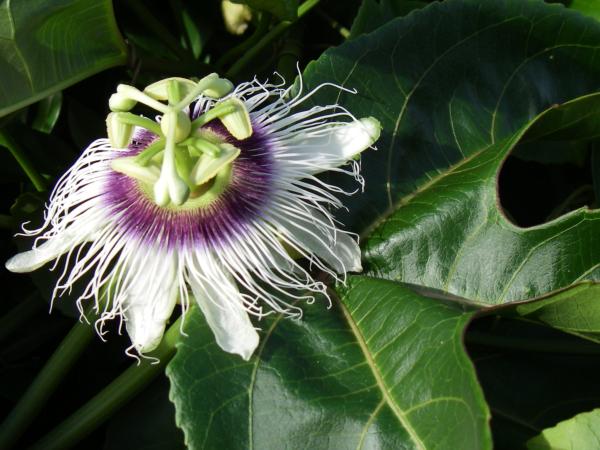
Update: I found a website all about passion fruit, including the historical explanation of how the Spanish missionaries taught the passion of Christ based on the elements of the flower (3 nails, five wounds, and a crown of thorns), hence the name.
So we now have beautiful flowers and 4-6 lilikoi fruit every day. It’s a bit of an Easter egg hunt, looking for the smooth, egg-shaped fruit in the grass and behind the herb garden, but the kid in me really enjoys that.
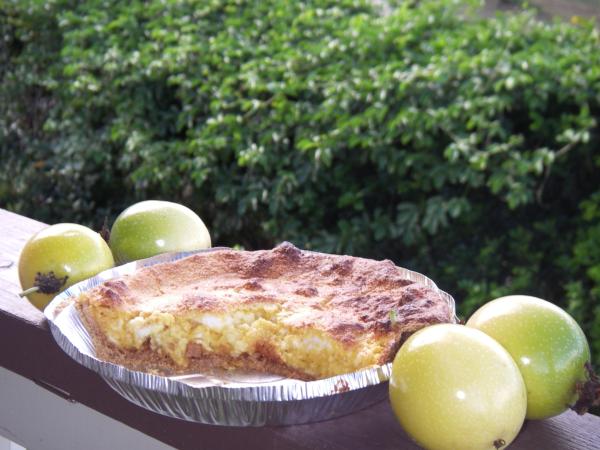
To find a use for the juice, my wife Sonja wanted to make a pie. We didn’t have the ingredients for a lilikoi cheesecake like you find in many restaurants, and she didn’t want just a plain pudding, so she improvised a sort of mousse by combining several recipes. It puffed up in the oven like a soufflé and then collapsed into a light golden mousse, but the result was delicious:
Finally, here is the recipe she improvised:
|
1 1/2 cups pure lilikoi juice Boil most of the juice with the water and most of the sugar. Stir in the mochiko and boil, then stir in the agar and boil once more. Let cool a little. Meanwhile, separate the eggs and mix yolks with the butter. Stir in the cooled juice. Whip the egg whites separtely and then fold into the mix. Pour into crust and bake 30+ minutes at 350°F (175°C or gas oven 4). |
I belong to a newsletter that has very nice recipe collectors. I mentioned that a year
ago we were in Hawaii and had a wonderful pie at a restaurant called Hamura’s Saimi.
We went on a backroads tour and our driver told us about this place. He said we
had to try the pie. I asked the newsletter readers if any of them knew how to make
this pie. Your website was sent to me. I want to thank you for this recipe. I live in
Boise, Idaho – we don’t see this type of pie. I am going to try to make it.
Thanks for submitting your recipe.
Sally
Thanks for sharing Sally, we love to see our creations spread through the internet. Let us know how it turns out, even if you have suggestions for making it better.
Just to be clear, we’ve never had the pie at Hamamura’s Saimin, so this recipe is not based on theirs at all. But we’ll have to go someday, because I have heard their pie is good, too.
Please, anyone, tell me where
or where do I find Lilikoi juice…
frozen, fresh, canned or any
method …..in Maui we had
the most delightful Lilikoi
Mousse Pie…..I have tried many
websites to no avail…..thank you.
Pat
Hi Pat,
Here is one website that has juice, syrup, jelly, and lots of other good stuff:
http://www.auntylilikoi.com/passion_fruit_syrup.php
Plus, Aunty Lilikoi is made on Kaua’i, right in Waimea town. I’ve stopped by her store/kitchen, and met her while she was making a batch of the wasabi mustard one day.
I have a hard time following recipes, even my own. So my new one is a bit smaller (and still overflows the crust)
1 cup juice, 1/4 cup water, 1 tbsp arrowroot powder, 1 t agar
Butter sugar and eggs stay the same.
Mix arrowroot starch, agar, a bit of sugar with 1/4 cup water
Whip butter and eggs yolks and most sugar, add lilikoi juice and starch mix, boil. (Stir constantly)
Cool as long as possible. Whip egg whites with the rest of the sugar (or a bit more if you like sweet or forgot to save some), fold it together with the lilikoi mix (if that is too warm it will not work). Chill and eat raw or bake.